

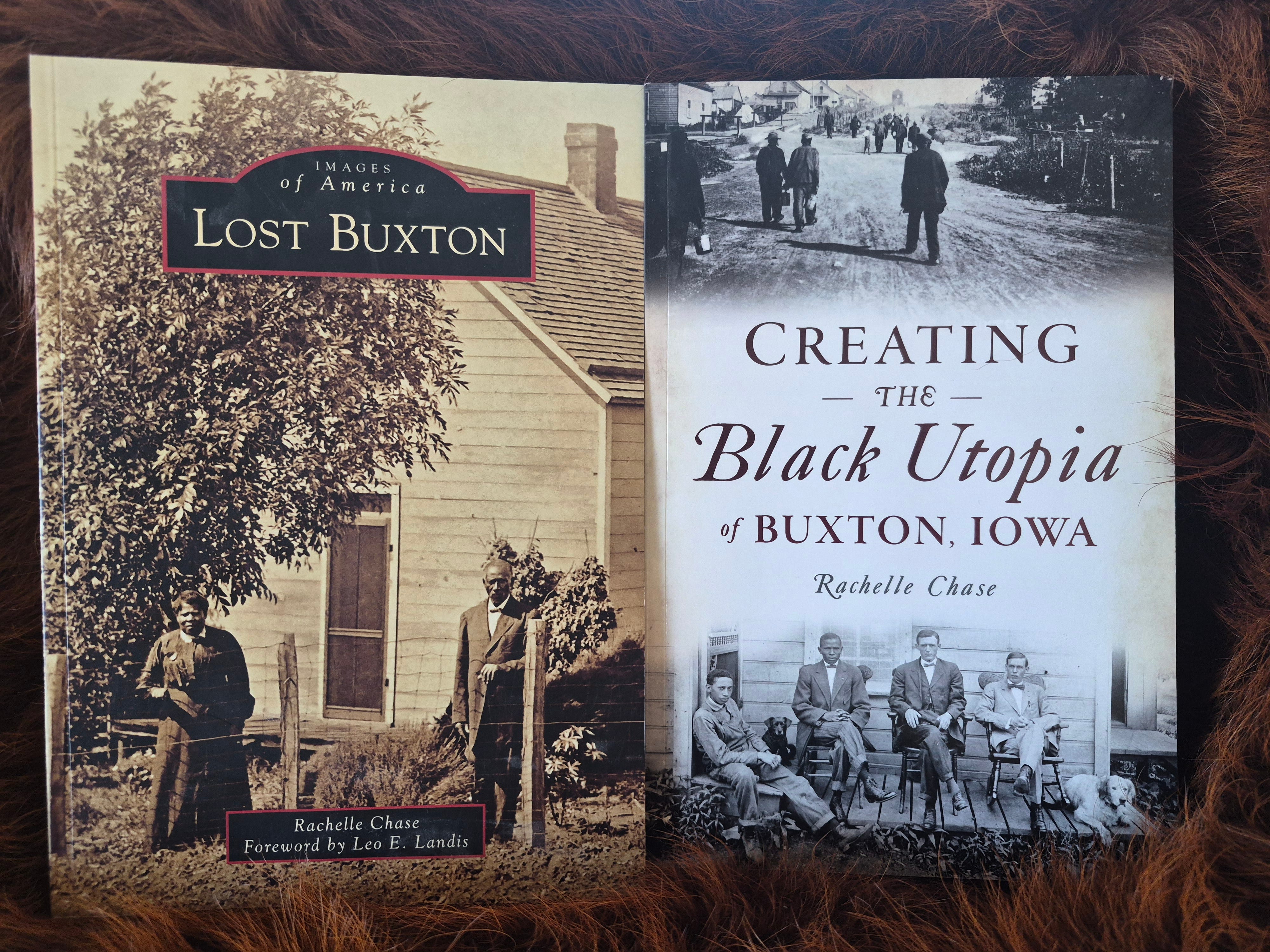
Books about late 19th and early 20th century racial integration in rural Iowa. Author Rachelle Chase lives in Ottumwa not far from where nearly 6000 Iowans lived in Buxton. Over half of them African American.
Martin Luther King, Jr. Day was first celebrated in 1986. The law that put the holiday on the official calendar of federal holidays passed both houses of Congress in 1983 with veto proof majorities. In both houses, the majority of both Republicans and Democrats voted for the federal holiday.
I was 13 years old when the holiday became law, and 15 when it was first recognized in 1986.
In my world of small town Iowa, I realized racism still existed. I knew fathers of friends who openly told racist jokes. But I also felt that we were moving in the right direction and that the most extreme examples of racism were well behind us as a nation.
There were four school districts in our county. And as far as I knew, there was one black teenager. Rodney was from the second largest high school. Everybody knew him. He was bigger than life. Gregarious. Confident. Everybody’s friend.
In my teenage years of trying to make sense of the world, Rodney was my evidence that the reason there weren’t more people of color in my immediate world was that people of color hadn’t been drawn to our county like my German and Irish ancestors had. If they had, they would have been welcomed like we all welcomed and appreciated Rodney.
That was until one day in class with Mr. Burke, our American History and Government teacher. I don’t remember if it was junior or senior year. But I remember how the lesson blew up my assumptions and caused me to reconsider my view of the world.
He told us that our home town had been a sundown town.
Mr. Burke explained that people of color could drive through town. They could eat at the restaurants and purchase gas. But there were formal signals that they weren’t welcome to stay.
He explained that a sundown town was a community that made it clear “N-word, don’t let the sun go down.”
I realized the fact that Rodney was the only black high schooler in my county wasn’t because people of color simply hadn’t settled there. It was because our communities made sure people of color didn’t.
As I went off to college, I told myself that most people weren’t racist anymore, but some people weren’t comfortable with a culture other than their own. I framed this as not about skin color but about culture. My liberal arts education blew that up. Racism was much deeper and far more complicated than my life experience had suggested.
In seminary outside of Chicago, a number of my fellow seminarians preparing to become Catholic priests were from other parts of the world. Some were immigrants like my classmate from Poland but who had immigrated as a young person. Others were studying in the United States but were headed back to Africa and China.
Some of my classmates who I felt were going to make great pastors surprised me by complaining about our cohorts from Africa and Asia. They suggested that these men weren’t appreciative enough of the opportunities we were giving them. I remember one classmate said something like “Nothing is ever enough for them” in a tone that felt hateful.
I was in my mid 20s. I had French and History majors and enough religious studies and philosophy for almost a third major under my belt. I had studied in France and Colombia. My world had expanded by galaxies since cruising in the county seat town between Pizza Hut at one end and McDonalds at the other. I’d traveled so many miles since goofing around with Rodney on a Saturday night. And here I was learning more about his life and the lives of my other fellow Americans that hadn’t yet crossed my mind.
In 2024, I read the two books in the above photo by Rachelle Chase, Lost Buxton and Creating the Black Utopia of Buxton, Iowa. Chase has done some of the most important work documenting the coal mining company town of Buxton in Monroe and Mahaska Counties. I’ve gotten to know Rachelle over the past couple of years. We’re both members of the Iowa Writers Collaborative.
I don’t think I’d ever heard of Buxton before Chase published her first book in 2017. By the time she published the second in 2019, the knowledge of Buxton had grown exponentially across our state.
This is the opening paragraph of the Foreword in Lost Buxton.
Among the most compelling Iowa stories is that of Buxton, a coal mining town largely in Monroe County, with a peak population of between 5,000 and 6,000 residents in the era from 1900 to the 1920s. The community of miners would not be surprising except for the fact that the majority were African American. This integrated community defied the racial norms in many ways as African Americans served in leadership roles and held professional positions in the community.
Now I can’t get the story out of my head. As a teenager, I was so convinced the racism now exploding across our nation had gone away. Today, people of color are profiled, physically detained, and even disappeared by the force of our own federal government.
The following quote from Chase’s second book hit me far harder than just a historical fact. It touched me emotionally. It jolted me into a deeper, more personal understanding of racism in the United States.
[Hobart “Hobe” Armstrong] lived a half mile outside of Muchakinock on 296 acres of land he owned and on which he had ninety-two horses, mainly Thoroughbred, and one hundred hogs. He owned the only meat market in town.
Hobe was a black man. This description is of his life in the late 1800s in Mahaska County. He later moved his meat market to Buxton. His wealth was significant, and it was grounded in rural Iowa.
With all I’ve learned since my faulty assumption that I grew up in a nearly all white community simply because people of color hadn’t wanted to live there, I can still learn more. Assumptions I didn’t even know I still held can crack, crumble, and fall away. I can still be surprised by the depth of both conscious and unconscious racism.
When Iowans created an environment that welcomed people of color, they came, just like my German and Irish ancestors had. When we created an environment of exclusion, hostility, and violence, they didn’t.
I wonder how many black families in Mahaska and Monroe Counties dreamed of farming and making their lives in rural Iowa but were driven away when the coal ran out? I wonder what happened to Hobe Armstrong’s family, his wealth, and his sizable farming operation?
I wonder how many people of color would have decided to set down roots in rural communities across Iowa like the one I grew up in?
Racism kept them from realizing those dreams.
Rural Iowa for the most part has declined almost every decade since Buxton disappeared after the coal ran out. The only exceptions are those rural communities that have welcomed or at least tolerated new Iowans coming from other countries. Yes, immigrants and almost all people of color.
Cass County where I grew up had a population of 21,274 in1900. In 2020, the population was 13,127.
Racism has kept Iowa from realizing our dreams.
Racism is a cancer. Anti-racism is the work we are called to embrace. We all must commit to continuing to open our minds and hearts for growth. We need to be willing to put our bodies into action to fight back.
After the civil rights movement to which so many Americans gave their lives, including Dr. Martin Luther King, Jr., I grew up thinking we’d turned a corner and overt racism was behind us.
I keep learning it’s not. We’re watching daily that it’s not.
I’m a member of the Iowa Writers Collaborative. Please take a look at this amazing group of Iowans publishing our work on Substack and keeping community-based local journalism and commentary alive. It’s an honor to be among this group. Subscribe for free to receive two weekly roundups in your inbox of a broad collection of diverse writing about Iowa, our nation, and our world.
I’ve read these books! They are amazing—heartbreaking and inspiring.
Great column. You do a good job of showing how important it is to learn both the good and the bad in our history. You were very fortunate to have a high school teacher who was so honest with your class about the history of Anita. My own government teacher was less progressive. I try to do that in my history classes. Last fall we talked about the complicated racial history of Dubuque. In 1839 an enslaved Dubuquer named Ralph Montgomery sued for his freedom and won. A year later a free Black man named Nathaniel Morgan was lynched in Dubuque. Both stories are a part of our history, and both stories tell us something about the place we call home.